

European style
Mediterranean interior design
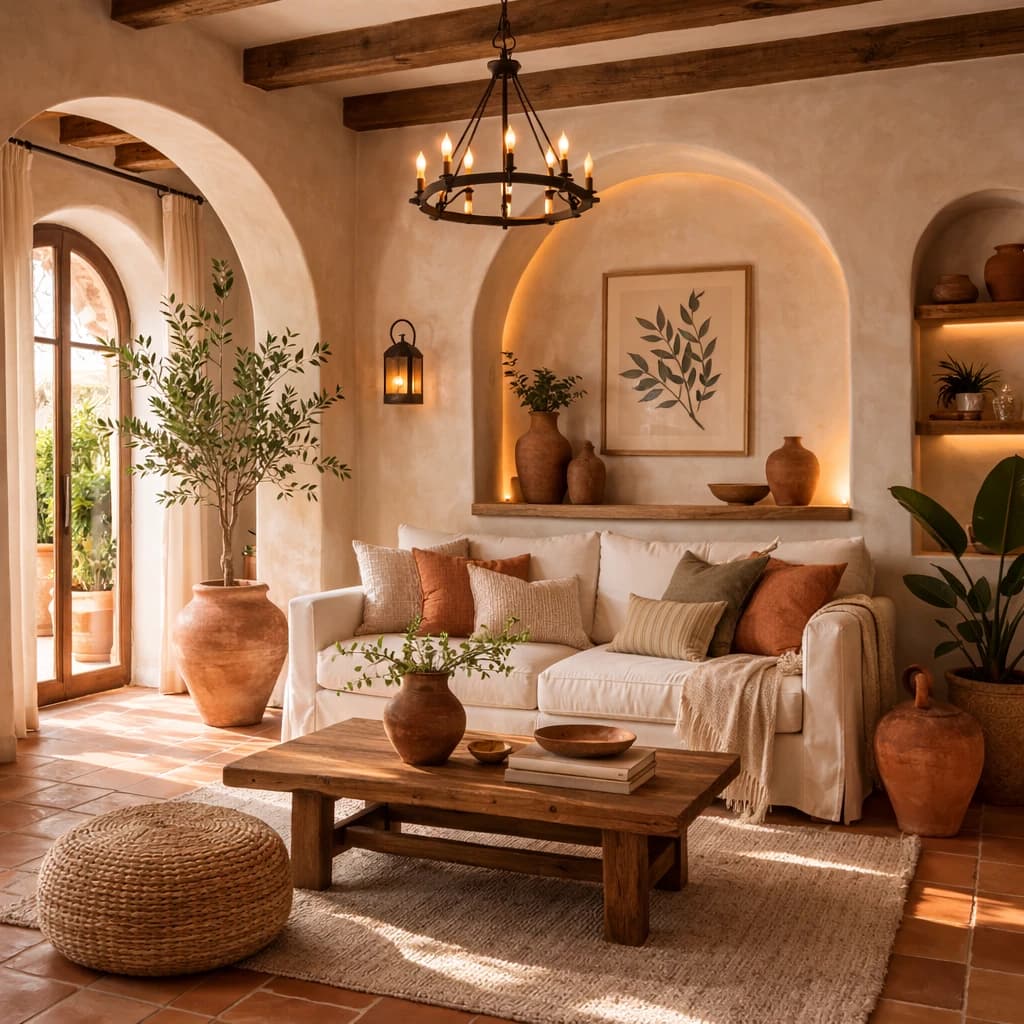
Mediterranean interior design is a warm, sun-oriented style built on terracotta, plaster walls, arches and earth tones. It comes from the coastal architecture of Spain, Italy, Greece and southern France, where thick walls and shaded openings keep rooms cool.
What defines Mediterranean
- Colors
- Limewash white, Terracotta, Olive, Aegean blue, Ochre, Warm sand
- Materials
- Lime plaster and limewash walls; Terracotta floor and roof tiles; Glazed and hand-painted ceramic tiles
- Key pieces
- An arched doorway, niche or alcove; A plastered bench or built-in seating; A long, solid wooden dining table with iron detail
- Best rooms
- Kitchen, Living room, Dining room, Bathroom, Entryway
- In Interify
- Mediterranean — Terracotta, arches & warm earth tones
Where Mediterranean comes from
The style is a response to climate before it is a decorating choice. Thick masonry walls, small deep windows, arched openings and tiled floors all exist to hold back heat, and they give Mediterranean rooms their characteristic shade, soft edges and cool floors underfoot. Lime plaster, used because it breathes, is why the walls look slightly uneven and absorb light instead of reflecting it.
Local materials set the palette. Fired clay gives the terracotta floors and roof tiles, olive and citrus give the greens, the sea and painted woodwork give the blues, and limewash gives the chalky whites of the Greek islands and Andalusia. Glazed tiles, a Moorish inheritance in Spain and Portugal, provide the one patterned surface in an otherwise plain room.
The mood is relaxed, bare-footed and generous. Furniture is low and solid, there is little upholstery, and plants stand indoors as well as out. Compared with other warm styles, a Mediterranean room is harder in finish, with more stone and plaster and less wood and fabric.
The palette
The colors Mediterranean rooms are built on. Name one in a note and Interify works to it.
- Limewash white#f2ece2
- Terracotta#b96f4e
- Olive#7c7f52
- Aegean blue#3f6f8f
- Ochre#c99a4e
- Warm sand#d8c3a2
Materials and key pieces
Materials
- Lime plaster and limewash walls
- Terracotta floor and roof tiles
- Glazed and hand-painted ceramic tiles
- Travertine, limestone and marble
- Rough-sawn beams and olive wood
- Wrought iron and copper
- Rush, jute and woven cane
- Linen and cotton in plain weaves
Key pieces
- An arched doorway, niche or alcove
- A plastered bench or built-in seating
- A long, solid wooden dining table with iron detail
- Rush-seated or ladder-back chairs
- Glazed tile as a backsplash or stair riser
- Wrought iron lanterns and a simple pendant
- Large terracotta pots with olive, fig or citrus
- Unglazed clay jugs and bowls
Do and avoid
Do
- Treat plaster as the finish, not as a base for flat paint
- Keep whites warm and chalky so they hold the sunlight
- Round off openings and arch at least one of them where the structure allows
- Lay a large, plain floor: terracotta, stone or pale tile, with few rugs
- Bring the pattern in on one surface, usually glazed tile
- Leave windows mostly bare, or dress them with plain linen that moves
Avoid
- Cool gray walls and blue-white light
- Wall-to-wall carpet or dark laminate floors
- Glossy modern kitchens with handleless high-gloss fronts
- Heavy curtains that block the light the style depends on
- Nautical motifs, which belong to coastal style rather than this one
- Chrome and polished steel, which look cold next to plaster and clay
Rooms Mediterranean suits
The rooms this style has the most to say in. It works in any room you can photograph.
- Kitchen
- Living room
- Dining room
- Bathroom
- Entryway
Make it Mediterranean in your own room
Pick Mediterranean and it restyles the whole photo — furniture, floor, wall color, textiles and lighting — while the walls, windows, doors and the camera angle stay where they are. Mark anything you want changed on top of that and write what it should become.
Notes to try
- Walls
- “Warm limewash plaster walls in a chalky off-white, slightly uneven”
- Floor
- “Large terracotta floor tiles in a square grid, matte finish”
- Doorway
- “Turn the doorway into a plastered arch with rounded edges”
- Backsplash
- “Hand-painted blue and white ceramic tiles behind the counter”
- Corner
- “Large terracotta pot with an olive tree beside the window”
Photograph the room
Straight on, in daylight, with the whole wall in frame. A phone photo is enough.
Pick Mediterranean
Choose Mediterranean from the style picker, or write your own instruction for the whole room instead.
Mark and write
Draw around each piece or surface you want changed and write what it should become, as in the notes above.
What it costs to try
- Styles
- 20 interior style presets, or describe your own
- Free to start
- 3 credits on signup, no card needed
- Cost of a version
- 1 credit. Packs start at $9 for 30 credits, down to $0.16 a credit
- Time per version
- Usually about a minute
Questions about Mediterranean
What is Mediterranean interior design?
Mediterranean interior design is a warm style drawn from the coastal architecture of Spain, Italy, Greece and southern France: plaster or limewash walls, terracotta and stone floors, arched openings, wrought iron, and earth tones from clay, olive and the sea. Rooms are shaded and sparely furnished, with hard surfaces rather than heavy upholstery.
What colors are Mediterranean interiors?
Warm neutrals with a few saturated accents: chalky limewash whites and sands on the walls, terracotta and ochre from fired clay, olive and sage from the planting, and a deep sea blue on doors, tiles and ceramics. Keep the whites warm. A cool gray or blue-white wall makes the same terracotta floor look dusty rather than sunlit.
What is the difference between Mediterranean and coastal style?
Both face the sea, but they treat it differently. Mediterranean is warm and hard: clay, plaster, stone, iron, shade. Coastal is cool and soft: whites and blues, slipcovered upholstery, painted boards and as much daylight as possible. A terracotta floor under a plaster arch is Mediterranean; a white linen sofa on a pale painted floor is coastal.
Can I get a Mediterranean look without arches?
Yes. Arches are the most photographed feature, but the plaster finish, the warm white, the clay floor and the lack of clutter carry the style on their own. If you cannot change the structure, soften what you can: rounded plaster edges, an arched mirror or niche, and a large matte tiled floor. Those read as Mediterranean in a room with square openings.
Does Mediterranean style work in a cold, dark climate?
It works, with adjustments. The warm palette helps a gray climate, but the style assumes strong sun, so a dark northern room needs the lightest terracotta and sand tones, more lamps than a southern room would have, and warm bulbs. Underfloor heating makes a tiled floor comfortable; without it, a stone floor in a cold room is the part people regret.
Styles like this one
- Coastal styleBoth are seaside styles; coastal is cooler, lighter and more upholstered
- Rustic styleShares beams, rough surfaces and solid wooden furniture
- Balinese styleAnother warm-climate style built on natural stone, carved detail and indoor planting
- French Provincial styleOverlaps in southern France, with limestone floors and painted wood in both
- All stylesEvery one of the 20 presets, grouped as the picker groups them.
See your room in Mediterranean
Upload a photo, pick Mediterranean and mark what should change. You start with 3 credits and no card.