

American style
Mid-Century Modern interior design
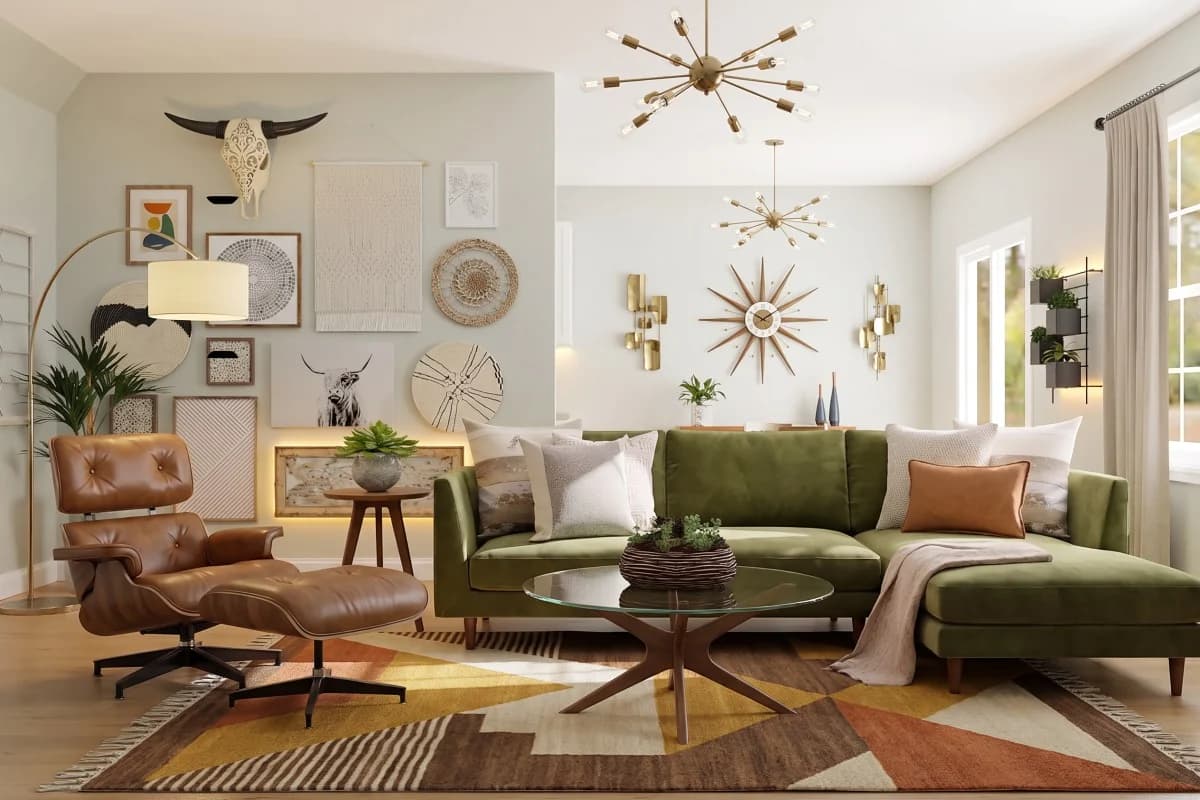
Mid-century modern is a style from roughly 1945 to 1970 built on warm wood, tapered legs, organic shapes and large windows. Furniture is low and light, ornament is absent, and the curve of a chair back or a table edge does the decorating.
What defines Mid-Century Modern
- Colors
- Teak, Off white, Mustard, Burnt orange, Avocado, Teal
- Materials
- Teak, walnut and oak; Molded plywood and fiberglass; Chrome, brass and bent steel
- Key pieces
- A low sofa on splayed wooden legs; A lounge chair with a molded shell or a plywood frame; A sideboard or credenza in teak or walnut
- Best rooms
- Living room, Dining room, Home office, Bedroom, Entryway
- In Interify
- Mid-Century Modern — Retro furniture, warm wood & organic shapes
Where Mid-Century Modern comes from
The style came out of postwar optimism and new manufacturing. European modernism had arrived in the United States with emigrating architects and designers, and American factories that had been making military equipment turned to molded plywood, fiberglass and bent steel. Designers including Charles and Ray Eames, Eero Saarinen and George Nelson used those processes to make furniture that was light, cheap to ship and shaped by the body.
In parallel, Danish cabinetmakers were producing the warm teak and oak pieces that still define the look in most people's minds, and the two currents were sold together as modern living. Houses followed: open plans, low rooflines, floor-to-ceiling glass and a direct relationship to the garden, documented most famously in the Case Study Houses in California.
The term itself is later. The popular name was fixed by a 1984 book, Mid-Century Modern by Cara Greenberg, which is why the period is remembered as a single style although it covers two decades and several countries. The mood is cheerful, light and informal: warm wood against white walls, one or two saturated colors, and as little visual weight as possible.
The palette
The colors Mid-Century Modern rooms are built on. Name one in a note and Interify works to it.
- Teak#90643c
- Off white#f2efe8
- Mustard#c99a2e
- Burnt orange#bf5b2e
- Avocado#7f8a46
- Teal#2f6f74
Materials and key pieces
Materials
- Teak, walnut and oak
- Molded plywood and fiberglass
- Chrome, brass and bent steel
- Wool upholstery in flat weaves
- Leather, usually tan or black
- Glass: large panes, and smoked or opal shades
- Stone and brick on a fireplace wall
- Terrazzo and cork floors
Key pieces
- A low sofa on splayed wooden legs
- A lounge chair with a molded shell or a plywood frame
- A sideboard or credenza in teak or walnut
- A round pedestal or tulip dining table
- A globe, arc or starburst light fixture
- A graphic or geometric wool rug
- A plant stand with a trailing houseplant
- A bar cart in wood and brass
Do and avoid
Do
- Raise the furniture on legs so the floor runs underneath and the room looks larger
- Keep walls mostly plain and let the wood provide the warmth
- Pick one or two saturated colors and repeat them in textiles and art
- Mix a curve with the straight lines: one organic shape per room
- Choose warm woods, and keep their tone consistent across the big pieces
- Leave the windows as open as privacy allows; the style depends on light
Avoid
- Filling the room with retro reproductions until it reads as a set
- Heavy skirted upholstery sitting on the floor
- Cool gray woods and whitewashed finishes
- Ornament, moldings and carved detail
- Clashing several bright colors at full strength
- Treating every curve as mid-century; the period also prized straight, thin lines
Rooms Mid-Century Modern suits
The rooms this style has the most to say in. It works in any room you can photograph.
- Living room
- Dining room
- Home office
- Bedroom
- Entryway
Make it Mid-Century Modern in your own room
Pick Mid-Century Modern and it restyles the whole photo — furniture, floor, wall color, textiles and lighting — while the walls, windows, doors and the camera angle stay where they are. Mark anything you want changed on top of that and write what it should become.
Notes to try
- Sofa
- “Low teal wool sofa on splayed walnut legs, straight back, no skirt”
- Sideboard
- “Long teak credenza on tapered legs with sliding doors”
- Ceiling light
- “White globe pendant on a slim brass stem”
- Walls
- “Off-white walls with one mustard and burnt orange graphic print”
- Corner
- “Tall houseplant in a woven basket on a three-leg wooden stand”
Photograph the room
Straight on, in daylight, with the whole wall in frame. A phone photo is enough.
Pick Mid-Century Modern
Choose Mid-Century Modern from the style picker, or write your own instruction for the whole room instead.
Mark and write
Draw around each piece or surface you want changed and write what it should become, as in the notes above.
What it costs to try
- Styles
- 20 interior style presets, or describe your own
- Free to start
- 3 credits on signup, no card needed
- Cost of a version
- 1 credit. Packs start at $9 for 30 credits, down to $0.16 a credit
- Time per version
- Usually about a minute
Questions about Mid-Century Modern
What is mid-century modern interior design?
Mid-century modern is an interior style from roughly 1945 to 1970 built on warm woods such as teak and walnut, furniture raised on tapered legs, organic molded shapes, large windows and plain walls. Ornament is absent and the room is kept light and low, with one or two saturated colors carried through textiles and art.
What years count as mid-century modern?
Most sources use about 1945 to 1970, with the core years in the 1950s and early 1960s. The boundaries are loose because the name was applied retrospectively, by a 1984 book, to furniture and architecture from several countries. Pieces designed in the late 1930s and early 1970s are routinely sold under the same label.
What colors go with mid-century modern?
A warm neutral base of off-white, cream and teak, with saturated accents from the period: mustard, burnt orange, avocado and olive green, teal and a muted red. Two accents are usually enough. Cool grays and whitewashed woods belong to later styles and make the period furniture look out of place.
What is the difference between mid-century modern and Scandinavian design?
They overlap, because Danish modern furniture belongs to both. The difference is emphasis: Scandinavian rooms stay pale and restrained, with light woods and few colors, while mid-century modern allows warmer, darker woods, stronger color and more graphic pattern. A teak credenza with a mustard chair reads mid-century; the same credenza in a white room with wool and sheepskin reads Scandinavian.
How do I add mid-century style without buying antiques?
Start with the legs and the light. Furniture raised on slim tapered legs, a globe or arc fixture instead of a flush ceiling light, and one strong period color in the textiles will shift a room a long way. A single genuine or well-made wooden piece is worth more than a roomful of reproductions. You can mark the sofa, the light and the wall in one photo and try the combination first.
Styles like this one
- Scandinavian styleShares the period, the pale rooms and much of the furniture; Danish modern sits in both
- Contemporary styleMid-century shapes are a regular ingredient in current rooms
- Art Deco styleThe style it reacted against: the same interest in shape, with the gilding removed
- Eclectic styleOne teak piece is a common anchor in a layered, collected room
- All stylesEvery one of the 20 presets, grouped as the picker groups them.
See your room in Mid-Century Modern
Upload a photo, pick Mid-Century Modern and mark what should change. You start with 3 credits and no card.