

Asian style
Balinese interior design
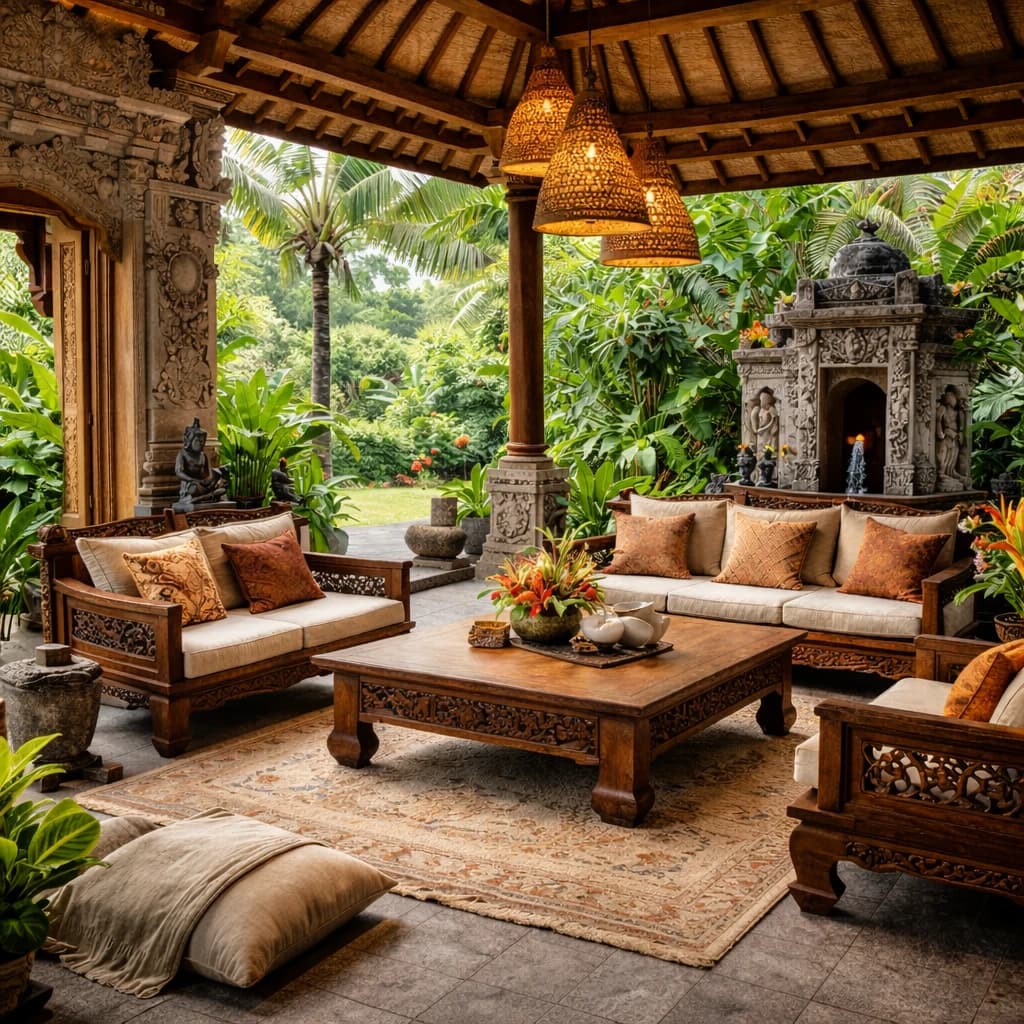
Balinese interior design is a tropical style built on dark hardwood, carved stone, woven natural fiber and open rooms that run into the garden. Planting is treated as part of the interior, and the boundary between inside and outside is kept deliberately loose.
What defines Balinese
- Colors
- Teak brown, Paras stone gray, Coconut cream, Banana leaf, Clay ochre, Lotus pink
- Materials
- Teak, ironwood and other tropical hardwoods; Bamboo, in poles and split panels; Alang-alang thatch and wood shingles
- Key pieces
- A carved hardwood daybed or bale-style bench; A four-poster bed with light cotton drapes; Carved stone panels, a spout or a garden figure
- Best rooms
- Bedroom, Bathroom, Living room, Entryway, Dining room
- In Interify
- Balinese — Tropical wood, open spaces & lush greenery
Where Balinese comes from
Traditional Balinese building is a compound rather than a single house: several open-sided pavilions, each called a bale, arranged around courtyards according to long-standing rules about orientation and use. Because the climate is warm and wet, the pavilions have deep eaves, raised floors and few walls, and air moves through them constantly.
The materials are local. Teak and ironwood frame and furnish the rooms, bamboo spans the lighter structures, alang-alang grass thatches the roofs, and paras, a soft volcanic sandstone, takes the carved panels and figures found at entrances and in garden walls. Textiles bring the pattern: batik and the resist-dyed ikat weaves of the region.
The mood is shaded, green and sensory. Dark wood and stone set against strong daylight, water in a pool or a spout, and plants at every scale are what make a room read as Balinese. Compared with Mediterranean interiors, the wood is darker and the planting far heavier; compared with other tropical styles, the carving and the stonework are what distinguish it.
The palette
The colors Balinese rooms are built on. Name one in a note and Interify works to it.
- Teak brown#6b4a30
- Paras stone gray#a9a39a
- Coconut cream#ece1cf
- Banana leaf#4f6b45
- Clay ochre#b57f4b
- Lotus pink#cf8c96
Materials and key pieces
Materials
- Teak, ironwood and other tropical hardwoods
- Bamboo, in poles and split panels
- Alang-alang thatch and wood shingles
- Carved paras volcanic stone
- Rattan, water hyacinth and seagrass
- Batik and ikat cotton
- Terrazzo and pebble-set floors
- Hammered copper and brass
Key pieces
- A carved hardwood daybed or bale-style bench
- A four-poster bed with light cotton drapes
- Carved stone panels, a spout or a garden figure
- Rattan or woven chairs with deep seats
- Lanterns and woven pendant shades
- A stone or terrazzo floor, often with pebble inlay
- Large planted vessels: palms, ferns, frangipani
- A water bowl, pond or outdoor shower
Do and avoid
Do
- Open the room toward the garden and keep the opening as wide as you can
- Put dark hardwood against pale plaster or stone so both read clearly
- Treat plants as furniture: a few large ones beat many small ones
- Use one carved element, in stone or wood, as the room's ornament
- Choose woven fiber for the seating and the shades
- Keep textiles light: cotton drapes that move, not heavy upholstery
Avoid
- Resort cliches: themed statues, tiki motifs and fake bamboo
- Carpet and heavy fabrics, which suit neither the climate nor the style
- Shiny chrome and glass against hardwood and stone
- Many competing bright colors; the green of the planting is the color
- Bright white cool lighting, which flattens the carving
- Leaving the windows undressed where sun control is needed; use wood shutters or blinds
Rooms Balinese suits
The rooms this style has the most to say in. It works in any room you can photograph.
- Bedroom
- Bathroom
- Living room
- Entryway
- Dining room
Make it Balinese in your own room
Pick Balinese and it restyles the whole photo — furniture, floor, wall color, textiles and lighting — while the walls, windows, doors and the camera angle stay where they are. Mark anything you want changed on top of that and write what it should become.
Notes to try
- Bed
- “Carved dark teak four-poster bed with light cotton drapes”
- Wall
- “Carved paras stone panel in soft gray behind the bed”
- Window
- “Replace the window with wide wood doors opening to planting”
- Corner
- “Large woven planter with a tall palm and ferns at its base”
- Floor
- “Terrazzo floor with pebble inlay in warm gray and cream”
Photograph the room
Straight on, in daylight, with the whole wall in frame. A phone photo is enough.
Pick Balinese
Choose Balinese from the style picker, or write your own instruction for the whole room instead.
Mark and write
Draw around each piece or surface you want changed and write what it should become, as in the notes above.
What it costs to try
- Styles
- 20 interior style presets, or describe your own
- Free to start
- 3 credits on signup, no card needed
- Cost of a version
- 1 credit. Packs start at $9 for 30 credits, down to $0.16 a credit
- Time per version
- Usually about a minute
Questions about Balinese
What is Balinese interior design?
Balinese interior design is a tropical style drawn from the open pavilions of Balinese compounds: dark tropical hardwood, carved volcanic stone, bamboo and thatch, woven rattan furniture, batik and ikat textiles, and rooms that open onto planted courtyards. Planting and water are treated as part of the interior rather than as decoration added at the end.
What is a bale?
A bale is an open-sided Balinese pavilion with a raised floor, timber posts and a deep thatched or shingled roof. A traditional household is made of several of them around courtyards, each used for a different purpose. The bale is why the style reads as airy and roofed rather than enclosed, and why daybeds and benches are such a common piece of furniture in it.
What colors suit a Balinese room?
A base of dark teak brown, gray stone and coconut cream, with the greens of the planting as the main color and clay ochre or a soft lotus pink as the only accents. The contrast that matters is dark wood against pale plaster or stone. Strong multi-colored schemes work against the style, because they compete with the garden.
Can Balinese style work in a cold climate?
Parts of it can. The open pavilion and the outdoor shower depend on a warm, wet climate, but the materials travel: carved dark hardwood, rattan and woven fiber, batik cushions, stone or terrazzo floors and large indoor plants. In a cold room, keep the planting and the wood and swap the open wall for a large glazed door, so the view stays part of the room.
How is Balinese style different from general tropical style?
Tropical is a loose description that covers everything from Caribbean pastels to palm-print wallpaper. Balinese is specific: dark hardwood rather than painted wood, carved paras stone, thatch, batik and ikat, and a plan built around open pavilions and courtyards. The carving and the stonework are the clearest signs that a room is Balinese rather than generally tropical.
Styles like this one
- Mediterranean styleAnother warm-climate style built on stone, shade and indoor planting
- Bohemian styleShares rattan, plants and layered pattern, with more color and less carving
- Rustic styleBoth leave heavy wood and rough stone visible as the finish
- Coastal styleA fellow seaside style, cooler and lighter, and often mixed with this one
- All stylesEvery one of the 20 presets, grouped as the picker groups them.
See your room in Balinese
Upload a photo, pick Balinese and mark what should change. You start with 3 credits and no card.