

Nordic style
Minimalist interior design
Minimalist interior design is a style that reduces a room to the few things it needs, leaving open space, simple forms and quiet surfaces. Interest comes from proportion, light and material rather than from pattern, ornament or color.
What defines Minimalist
- Colors
- Paper white, Warm plaster, Light gray, Concrete, Graphite, Natural oak
- Materials
- Flat matte paint and smooth plaster; Polished or honed concrete; Pale oak and ash veneer
- Key pieces
- One low sofa with a simple square profile; A single large artwork or none at all; Handleless, flush-front storage
- Best rooms
- Living room, Bedroom, Bathroom, Home office, Kitchen
- In Interify
- Minimalist — Fewer items, open space & simple forms
Where Minimalist comes from
Minimalism in interiors descends from early twentieth-century modernism, where architects stripped away applied ornament in favor of structure and proportion, and from the postwar art movement that gave the word its name. Traditional Japanese architecture, with its empty rooms, sliding screens and visible structure, was an acknowledged influence on both.
By the 1980s and 1990s the approach had become a recognizable domestic style, helped by architects who treated plaster, concrete and glass as finished materials and by the gallery-like white interior. The same decades produced the discipline it needs: concealed storage, flush detailing and services hidden in the fabric of the room.
The mood is quiet and composed. A minimalist room has fewer items than it comfortably could, which puts weight on each one, and it needs good daylight and clean lines to avoid feeling bare. In Interify the preset asks for fewer items, open space and simple forms, so expect it to clear a room rather than fill it.
The palette
The colors Minimalist rooms are built on. Name one in a note and Interify works to it.
- Paper white#f7f6f3
- Warm plaster#e3dcd2
- Light gray#c2c2bf
- Concrete#8e8d89
- Graphite#36373a
- Natural oak#cdb189
Materials and key pieces
Materials
- Flat matte paint and smooth plaster
- Polished or honed concrete
- Pale oak and ash veneer
- Glass and slim steel frames
- Honed stone, usually a single slab
- Plain cotton and linen
- Matte black or brushed metal fittings
- Large-format floor tiles
Key pieces
- One low sofa with a simple square profile
- A single large artwork or none at all
- Handleless, flush-front storage
- A plain rectangular table with a thin top
- Recessed or linear lighting, kept out of sight
- A long bench or ledge instead of several small pieces
- One sculptural chair as the room's only shape
- A single plant in a plain vessel
Do and avoid
Do
- Decide what the room is for, then remove what does not serve it
- Keep a consistent line: align the tops of doors, shelves and cabinets
- Hide storage, so the surfaces you leave visible can stay empty
- Let one material do the talking, such as a single stone or one wood
- Light the surfaces, not the objects, and keep the fixtures discreet
- Leave a generous empty floor area; the space is the feature
Avoid
- Treating minimalism as all-white; a warm neutral is easier to live with
- Open shelves full of objects, which undo the effect
- Many small furniture pieces instead of a few larger ones
- Visible cables, chargers and clutter on the one empty surface
- Cold, even lighting with no shadow or variation
- Removing so much softness that the room echoes
Rooms Minimalist suits
The rooms this style has the most to say in. It works in any room you can photograph.
- Living room
- Bedroom
- Bathroom
- Home office
- Kitchen
Make it Minimalist in your own room
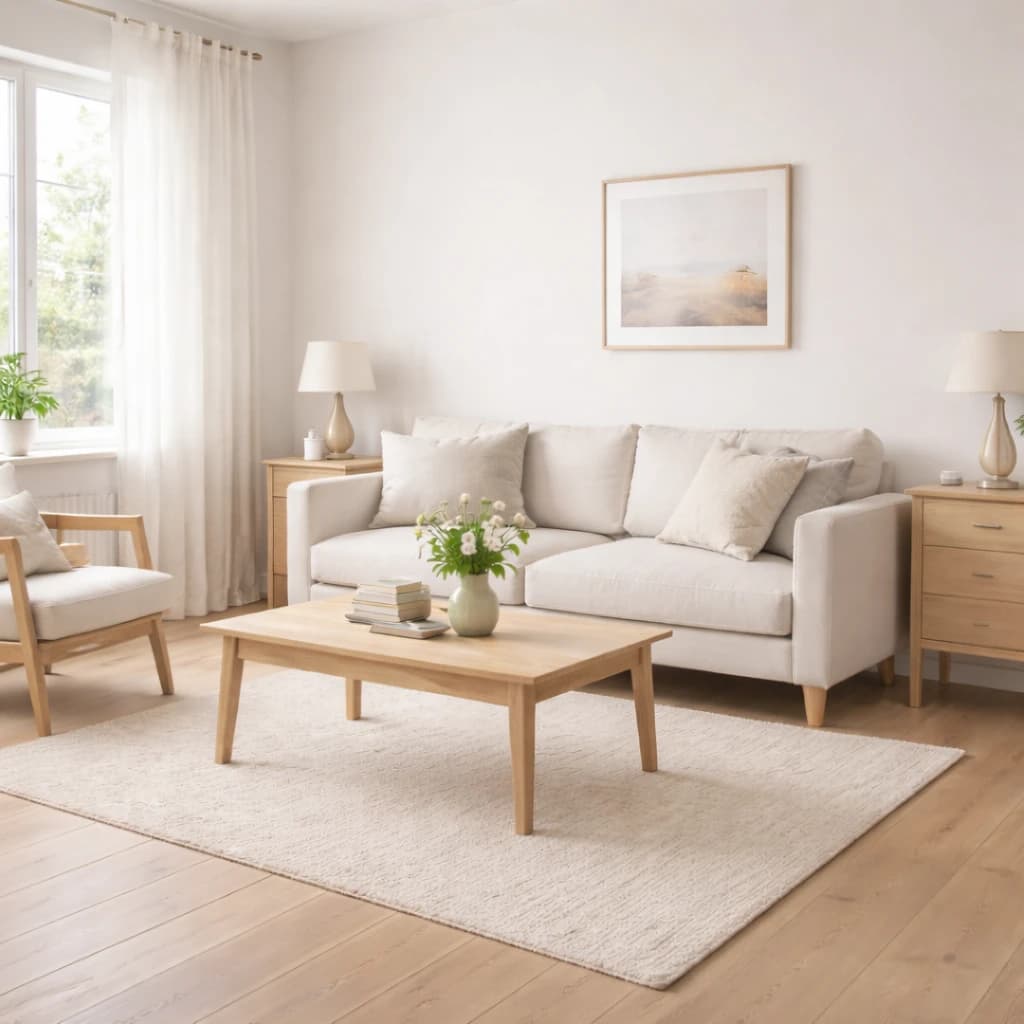
Pick Minimalist and it restyles the whole photo — furniture, floor, wall color, textiles and lighting — while the walls, windows, doors and the camera angle stay where they are. Mark anything you want changed on top of that and write what it should become.
Notes to try
- Walls
- “Smooth warm plaster walls in a flat off-white, no artwork”
- Sofa
- “Low square sofa in pale gray wool, no cushions, slim base”
- Storage
- “Full-height handleless cabinets in matte white, flush with the wall”
- Floor
- “Large-format honed concrete-look tiles with narrow joints”
- Coffee table
- “Single low rectangular table in pale oak, nothing on it”
Photograph the room
Straight on, in daylight, with the whole wall in frame. A phone photo is enough.
Pick Minimalist
Choose Minimalist from the style picker, or write your own instruction for the whole room instead.
Mark and write
Draw around each piece or surface you want changed and write what it should become, as in the notes above.
What it costs to try
- Styles
- 20 interior style presets, or describe your own
- Free to start
- 3 credits on signup, no card needed
- Cost of a version
- 1 credit. Packs start at $9 for 30 credits, down to $0.16 a credit
- Time per version
- Usually about a minute
Questions about Minimalist
What is minimalist interior design?
Minimalist interior design reduces a room to the few things it needs: open floor space, simple forms, concealed storage and quiet surfaces. Pattern, ornament and strong color are kept out, so proportion, daylight and the material itself carry the room. It descends from modernist architecture and from traditional Japanese interiors.
Is minimalist design always white?
No. White is common because it keeps surfaces quiet, but warm plaster, pale gray, oak and graphite are all standard, and some minimalist rooms are entirely dark. An all-white room is harder to live with than a warm neutral one, because every mark shows and the light can feel flat. The discipline is about how much is in the room, not about the color.
How do I make a room minimalist without it feeling cold?
Keep the reduction and add back texture and warmth: a warm white rather than a blue-white, one wood surface, a wool rug, and lamps with warm bulbs at a few different heights. Soft materials also absorb sound, which is what usually makes a sparse room feel unfriendly. One large plant does more than several small objects.
What is the difference between minimalist and modern style?
Modern refers to a period, roughly the early to mid twentieth century, and its furniture and architecture. Minimalist refers to an approach that can be applied in any period: keep less. A modern room can be full of furniture and color; a minimalist room cannot. People often use modern to mean current, which adds to the confusion.
Does minimalism work in a small apartment?
It does, as long as there is somewhere for things to go. Minimalism in a small space depends on built-in or concealed storage, because the look only holds while surfaces stay clear. Choose fewer, larger pieces rather than many small ones, and keep one wall and one floor area completely empty. You can test that emptiness on a photo of your own room before moving anything.
Styles like this one
- Scandinavian styleThe friendlier neighbor: the same restraint with more wood and textile
- Japanese styleAn older tradition of empty, carefully proportioned rooms that minimalism drew on
- Contemporary styleShares clean lines and mixed materials, with more color and contrast
- Industrial styleAlso leaves materials bare, though it exposes structure rather than hiding it
- All stylesEvery one of the 20 presets, grouped as the picker groups them.
See your room in Minimalist
Upload a photo, pick Minimalist and mark what should change. You start with 3 credits and no card.