

American style
Contemporary interior design
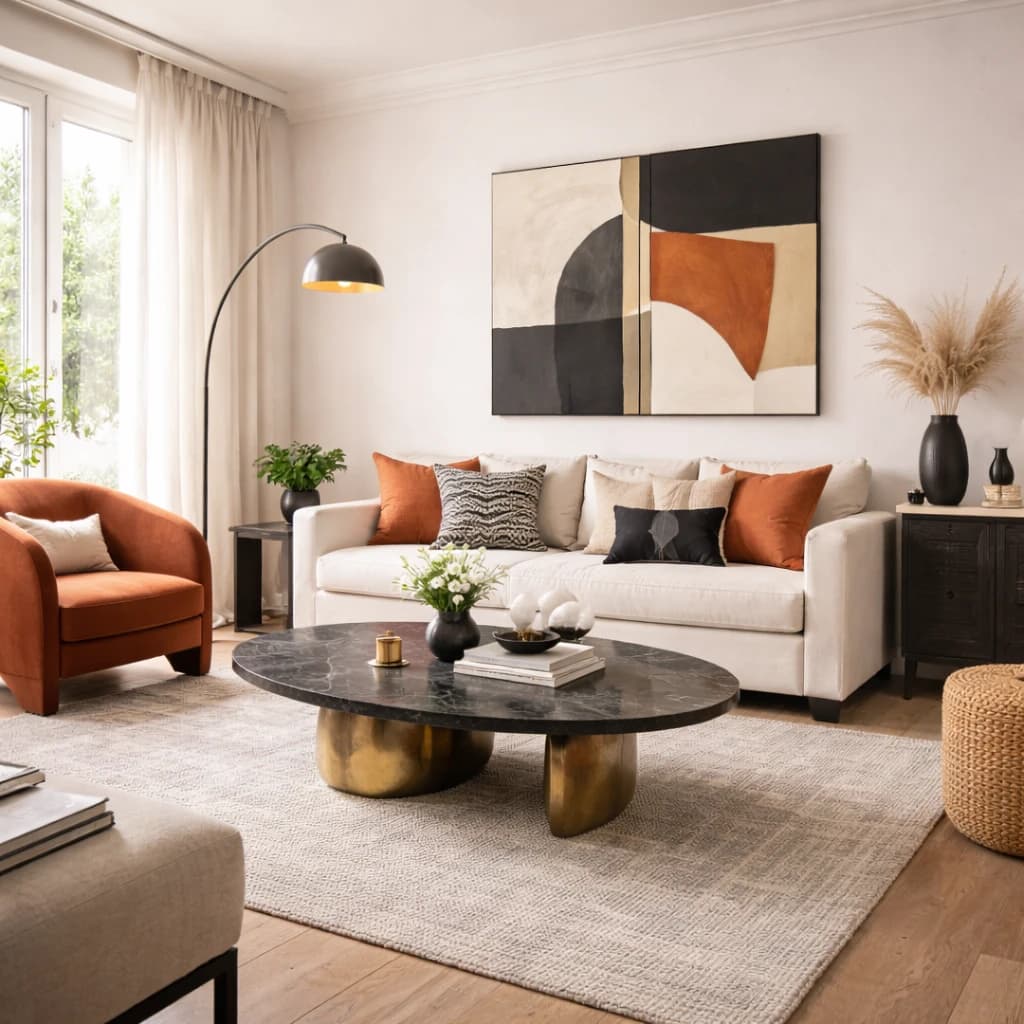
Contemporary interior design means what is being designed now, so it describes current practice rather than a fixed historical style. In practice it means clean-lined furniture, mixed materials in one room, a neutral base and a small number of bold accents.
What defines Contemporary
- Colors
- Warm white, Greige, Plaster beige, Graphite, Deep olive, Burnt amber
- Materials
- Microcement and plaster finishes; Oak and walnut veneer; Engineered and natural stone with visible veining
- Key pieces
- A low sofa with rounded arms in a textured fabric; A sculptural armchair as the room's one shape; A stone or stone-look table with a thick edge
- Best rooms
- Living room, Kitchen, Bathroom, Bedroom, Home office
- In Interify
- Contemporary — Current trends, mixed materials & bold accents
Where Contemporary comes from
Contemporary is the one style label that moves. Modern refers to a period that has ended, roughly the early to mid twentieth century, while contemporary refers to whatever is current, so a room described as contemporary in 1995 looks different from one described that way today. Writing about it honestly means naming what is common now and accepting that it will date.
What has stayed stable is the approach. Contemporary rooms favor simple, low-ornament shapes; they mix materials deliberately, so stone, wood, metal and textile meet in the same view; and they keep walls and large surfaces neutral so a few strong pieces can carry the room. Open plans, large glazing and concealed storage come with the territory.
Current taste, as taste rather than as fact, leans warm: warmer neutrals and plaster finishes rather than the cool grays of the 2010s, curved and rounded upholstery, fluted and ribbed surfaces, bouclé and heavy textures, and matte black or aged brass metalwork. Those preferences will shift, which is the honest thing to say about any contemporary room.
The palette
The colors Contemporary rooms are built on. Name one in a note and Interify works to it.
- Warm white#f5f2ec
- Greige#c7bfb3
- Plaster beige#ded2c2
- Graphite#3b3b3c
- Deep olive#5c6246
- Burnt amber#b06a3b
Materials and key pieces
Materials
- Microcement and plaster finishes
- Oak and walnut veneer
- Engineered and natural stone with visible veining
- Matte black and brushed brass metal
- Bouclé, wool and heavy textured weaves
- Fluted and ribbed wood or glass panels
- Large-format porcelain tile
- Clear and reeded glass
Key pieces
- A low sofa with rounded arms in a textured fabric
- A sculptural armchair as the room's one shape
- A stone or stone-look table with a thick edge
- Handleless or fluted storage, floor to ceiling
- One large artwork, oversized rather than grouped
- A linear or sculptural pendant over the table
- A deep-pile or high-low textured rug
- A single large plant in a plain vessel
Do and avoid
Do
- Keep the large surfaces neutral and spend the color on two or three pieces
- Mix materials on purpose: let stone, wood, metal and textile meet in one view
- Choose one metal finish and repeat it across the room
- Balance the straight lines with one curve, in a chair, a mirror or an arch
- Light in layers, with the fixtures themselves kept simple
- Keep storage concealed so the clean lines survive daily use
Avoid
- Chasing every trend at once, which dates a room faster than any single choice
- Treating contemporary as a synonym for cold; warmth comes from texture and wood
- Gray on gray with no contrast or material change
- Many small decorative objects instead of a few larger ones
- Mixing three or four metal finishes
- Copying a model home exactly; the style assumes editing for the room you have
Rooms Contemporary suits
The rooms this style has the most to say in. It works in any room you can photograph.
- Living room
- Kitchen
- Bathroom
- Bedroom
- Home office
Make it Contemporary in your own room
Pick Contemporary and it restyles the whole photo — furniture, floor, wall color, textiles and lighting — while the walls, windows, doors and the camera angle stay where they are. Mark anything you want changed on top of that and write what it should become.
Notes to try
- Sofa
- “Low sofa with rounded arms in cream bouclé, no visible legs”
- Walls
- “Warm plaster-finish walls in a soft beige, matte and seamless”
- Coffee table
- “Round travertine coffee table with a thick edge”
- Cabinet
- “Full-height fluted oak storage with no visible handles”
- Ceiling light
- “Slim linear pendant in matte black over the table”
Photograph the room
Straight on, in daylight, with the whole wall in frame. A phone photo is enough.
Pick Contemporary
Choose Contemporary from the style picker, or write your own instruction for the whole room instead.
Mark and write
Draw around each piece or surface you want changed and write what it should become, as in the notes above.
What it costs to try
- Styles
- 20 interior style presets, or describe your own
- Free to start
- 3 credits on signup, no card needed
- Cost of a version
- 1 credit. Packs start at $9 for 30 credits, down to $0.16 a credit
- Time per version
- Usually about a minute
Questions about Contemporary
What is contemporary interior design?
Contemporary interior design means what is being designed now, so it tracks current practice rather than a fixed period. In practice it means clean-lined, low-ornament furniture, several materials mixed deliberately in one room, neutral walls and floors, and a small number of bold pieces or colors carrying the room.
What is the difference between contemporary and modern interior design?
Modern names a historical period, roughly the early to mid twentieth century, with its own furniture, architects and palette. Contemporary names the present, so it changes as taste changes. A room with a teak credenza and a molded plastic chair is modern; a room with a bouclé sofa, a plaster wall and a travertine table is contemporary today and will be dated later.
What colors are used in contemporary interiors?
A neutral base carries most of the room: warm white, greige, plaster beige and graphite, with wood and stone providing variation. Accents are few and strong, often a deep green, a burnt amber, an ink blue or black. The warm neutral base is current taste; the cooler gray palette common in the 2010s is the same approach in a different key.
How do I keep a contemporary room from dating quickly?
Put the money and the permanence in the neutral parts, the floor, the walls, the cabinets and the layout, and keep the trend-driven choices in the things that are easy to change: cushions, lamps, chairs, paint. Then take one or two current details rather than all of them. A room with every trend in it is the one that dates fastest.
Is contemporary style the same as minimalist?
No, though they overlap. Minimalism is about how little is in the room, and it holds in any period. Contemporary is about being current, and a contemporary room can be layered, colorful and full. Many rooms are both, because current taste favors clean lines, but a contemporary room with a patterned rug and a gallery wall is still contemporary.
Styles like this one
- Minimalist styleThe same clean lines taken further, with less color and contrast
- Mid-Century Modern styleIts furniture shapes are a standard ingredient in contemporary rooms
- Industrial styleShares bare materials and large-scale surfaces, in a darker key
- Art Deco styleFluted surfaces, strong veining and bold accents are a shared language
- All stylesEvery one of the 20 presets, grouped as the picker groups them.
See your room in Contemporary
Upload a photo, pick Contemporary and mark what should change. You start with 3 credits and no card.