

European style
Art Deco interior design
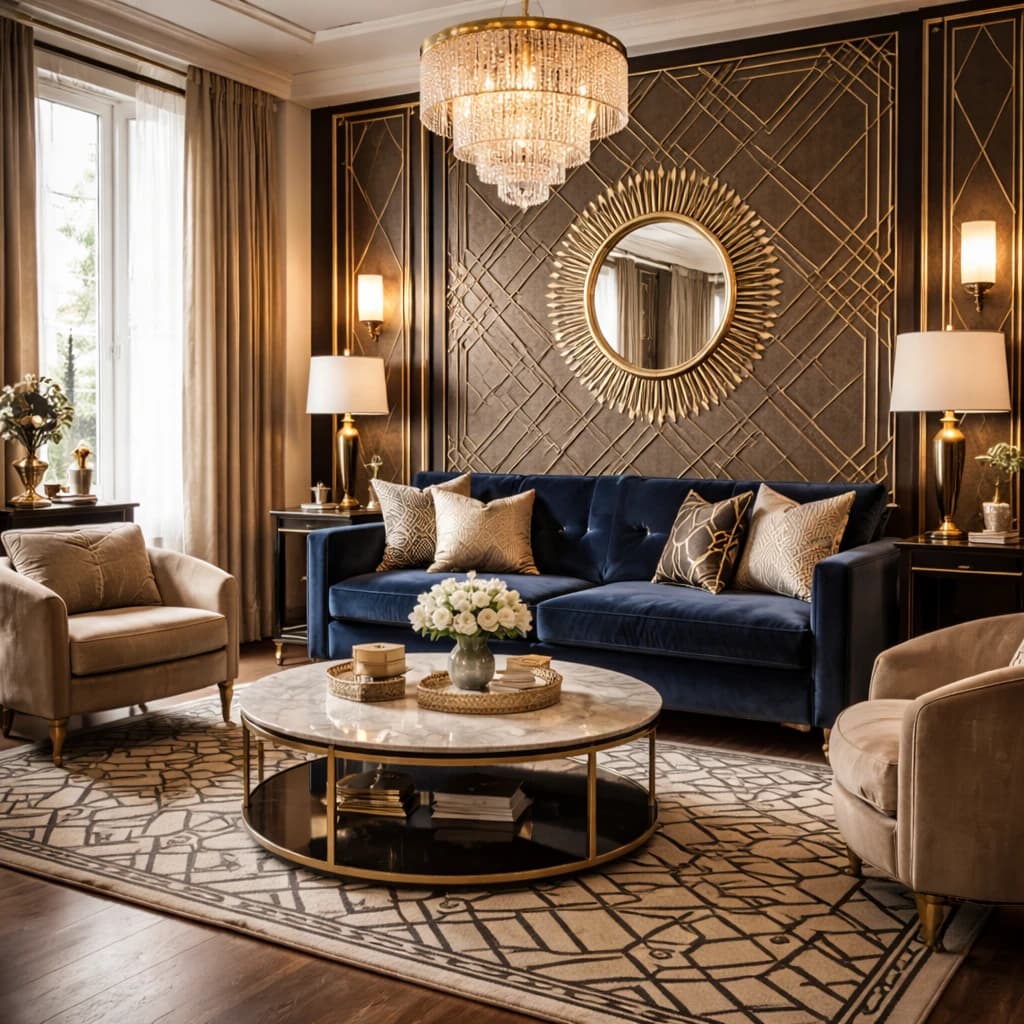
Art Deco interior design is a decorative style from the 1920s and 1930s built on bold geometric patterns, polished materials and metallic accents, usually gold or brass. It is symmetrical, glossy and deliberately luxurious, in contrast to the plain modernism that followed it.
What defines Art Deco
- Colors
- Lacquer black, Antique brass, Emerald, Oxblood, Pearl, Smoke blue
- Materials
- Lacquered and high-gloss wood; Walnut, ebony and burr veneers; Brass, chrome and nickel
- Key pieces
- A low curved sofa in velvet, tightly upholstered; A pair of club or tub chairs placed symmetrically; A cocktail cabinet or bar cart in lacquer and brass
- Best rooms
- Living room, Dining room, Bathroom, Bedroom, Home office
- In Interify
- Art Deco — Geometric patterns, gold accents & luxury
Where Art Deco comes from
The style took its name from the 1925 Exposition internationale des arts décoratifs et industriels modernes in Paris, and it spread through hotels, cinemas, ocean liners and apartment buildings between the wars. Designers borrowed stepped and fan-shaped motifs from Egyptian and Aztec sources, sunbursts and chevrons from machine-age imagery, and lacquer techniques from Asia, then assembled them into something new and self-consciously modern.
Materials carried the message. Exotic veneers, shagreen, lacquer, inlaid marble, mirrored glass, chrome and brass gave surfaces a hard shine, and the invention of better electric lighting made that shine worth having. Furniture became low, broad and curved, with the stepped silhouettes and tight upholstery that still read as nineteen-thirties at a glance.
The mood is confident and theatrical. Rooms are arranged symmetrically around one strong feature, pattern is geometric rather than floral, and the palette is dark with metallic highlights. Because every surface reflects, Art Deco rooms depend on good lighting more than most styles do.
The palette
The colors Art Deco rooms are built on. Name one in a note and Interify works to it.
- Lacquer black#1c1b1a
- Antique brass#b08d4f
- Emerald#1f5c4d
- Oxblood#6e2b2b
- Pearl#ece6dc
- Smoke blue#4a5a6b
Materials and key pieces
Materials
- Lacquered and high-gloss wood
- Walnut, ebony and burr veneers
- Brass, chrome and nickel
- Marble with strong veining
- Mirrored and smoked glass
- Velvet and silk upholstery
- Shagreen, leather and inlay
- Terrazzo and geometric tile
Key pieces
- A low curved sofa in velvet, tightly upholstered
- A pair of club or tub chairs placed symmetrically
- A cocktail cabinet or bar cart in lacquer and brass
- A round or stepped mirror above the fireplace
- Fluted or reeded cabinet fronts
- A geometric rug with a chevron, sunburst or stepped pattern
- Opal glass and brass wall lights, in pairs
- A marble-topped console with metal legs
Do and avoid
Do
- Arrange the room symmetrically around one feature: a fireplace, a mirror, a bar
- Keep the geometry consistent: pick chevrons, fans or steps and repeat them
- Use one metal throughout, usually brass, and let it be the only shine on the walls
- Pair dark walls with a pale ceiling so the room does not close in
- Light it in layers, with wall lights at eye level as well as lamps
- Choose one strongly veined stone and give it a whole surface
Avoid
- Mixing brass, chrome and nickel in the same room
- Floral or organic pattern, which belongs to Art Nouveau rather than Deco
- Rustic or distressed wood finishes
- Too many small ornaments; the style wants fewer, larger gestures
- Cool white LED light, which makes velvet and lacquer look flat
- Gold-colored plastic standing in for metal
Rooms Art Deco suits
The rooms this style has the most to say in. It works in any room you can photograph.
- Living room
- Dining room
- Bathroom
- Bedroom
- Home office
Make it Art Deco in your own room
Pick Art Deco and it restyles the whole photo — furniture, floor, wall color, textiles and lighting — while the walls, windows, doors and the camera angle stay where they are. Mark anything you want changed on top of that and write what it should become.
Notes to try
- Sofa
- “Low curved sofa in emerald velvet with brass feet, tight upholstery”
- Wall
- “Deep smoke blue wall with a brass fan-shaped mirror above the fireplace”
- Floor
- “Geometric rug with a black and cream chevron pattern”
- Cabinet
- “Black lacquered cabinet with fluted doors and brass handles”
- Wall lights
- “Pair of opal glass and brass wall lights either side of the mirror”
Photograph the room
Straight on, in daylight, with the whole wall in frame. A phone photo is enough.
Pick Art Deco
Choose Art Deco from the style picker, or write your own instruction for the whole room instead.
Mark and write
Draw around each piece or surface you want changed and write what it should become, as in the notes above.
What it costs to try
- Styles
- 20 interior style presets, or describe your own
- Free to start
- 3 credits on signup, no card needed
- Cost of a version
- 1 credit. Packs start at $9 for 30 credits, down to $0.16 a credit
- Time per version
- Usually about a minute
Questions about Art Deco
What is Art Deco interior design?
Art Deco interior design is a decorative style from the 1920s and 1930s that combines bold geometric pattern, polished materials and metallic accents. Rooms are symmetrical and glossy: lacquered and veneered wood, marble, mirrored glass, velvet upholstery and brass, arranged around one strong feature such as a fireplace or a bar.
What is the difference between Art Deco and Art Nouveau?
Art Nouveau came first, around 1890 to 1910, and its lines are organic: curving stems, flowers, insects and flowing female figures. Art Deco, from the 1920s and 1930s, is geometric and machine-age: chevrons, sunbursts, steps and fans. If the pattern looks grown, it is Nouveau; if it looks drawn with a compass and a ruler, it is Deco.
What colors are used in Art Deco interiors?
A dark base with metallic and jewel accents: black and deep browns, emerald green, oxblood, navy and smoke blue, with brass or gold against them and pearl or cream to lift the ceiling and the trim. Two or three colors is usual. The contrast between a dark field and one metal is what makes the geometry read.
Can Art Deco work in a small room?
Yes, and mirrors are the traditional answer: a large mirrored or fluted surface doubles the light a small Deco room gets from its gloss. Keep to one metal, one geometric pattern and fewer, larger pieces. The mistake in a small room is many small ornaments, which turn the style from confident to cluttered.
Is Art Deco the same as Hollywood Regency or Gatsby style?
They are related but not the same. Hollywood Regency is a later American look that keeps Deco's gloss and symmetry while adding brighter colors, prints and more decorative furniture. Gatsby style is a marketing phrase for the 1920s mood rather than a defined style. Art Deco is the historical movement with a documented palette, geometry and set of materials.
Styles like this one
- Mid-Century Modern styleThe style that followed it: the same love of shape, with less ornament and no gilding
- Chinese Classical styleArt Deco took up East Asian lacquer and inlay, Chinese lacquered screens among its sources
- Contemporary styleBoth mix materials freely and use bold accents against neutrals
- Industrial styleShares metal, dark tones and large-scale geometry
- All stylesEvery one of the 20 presets, grouped as the picker groups them.
See your room in Art Deco
Upload a photo, pick Art Deco and mark what should change. You start with 3 credits and no card.