

Asian style
Chinese Classical interior design
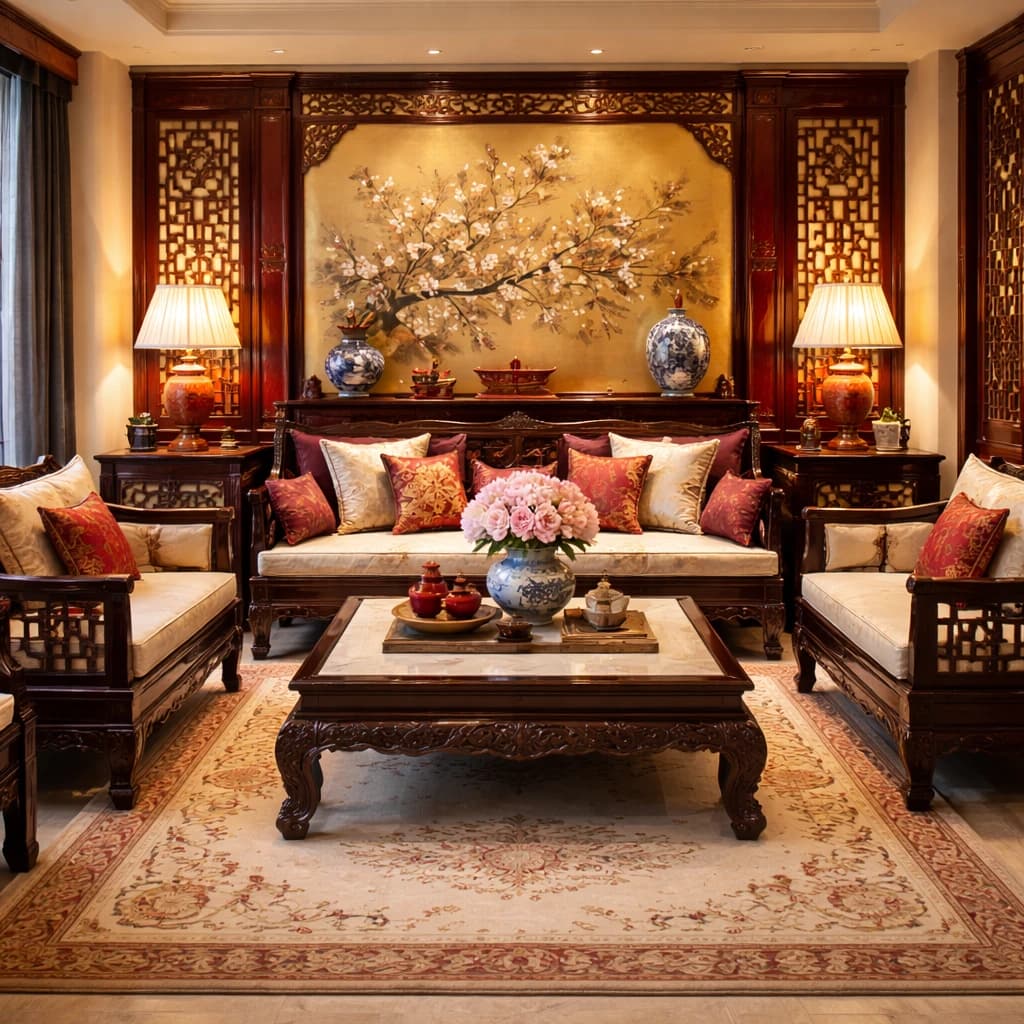
Chinese classical interior design is a formal style based on hardwood and lacquered furniture, silk textiles and symmetrical arrangement, with red and gold as its accent colors. Its furniture follows Ming and Qing dynasty forms, built with joinery rather than nails or glue.
What defines Chinese Classical
- Colors
- Cinnabar red, Gold leaf, Lacquer black, Huanghuali brown, Porcelain white, Jade green
- Materials
- Rosewood, elm and other dense hardwoods; Red and black lacquer; Silk, brocade and embroidered panels
- Key pieces
- A pair of horseshoe-back or yoke-back chairs; An altar or long side table against the back wall; A folding or standing screen with painted panels
- Best rooms
- Living room, Dining room, Home office, Bedroom, Entryway
- In Interify
- Chinese Classical — Lacquered furniture, silk & rich red accents
Where Chinese Classical comes from
The furniture came first. From the Ming dynasty onward, cabinetmakers worked dense tropical hardwoods such as huanghuali and zitan into chairs, tables and cabinets held together by mortise-and-tenon joinery, with little carving and very precise proportion. Qing dynasty pieces grew more elaborate, adding deep carving, inlay and the high-gloss red and black lacquer that most people picture first.
The room was arranged by rule as much as by taste. A principal hall was laid out symmetrically, with a pair of chairs flanking a central table against the back wall, screens and lattice panels dividing space without closing it, and the whole thing oriented for propriety and for the ideas of balance that also inform feng shui. Scholars kept a separate, plainer register: a desk, a stone, a scroll and an incense burner.
The mood is composed and ceremonious. Color is used sparingly and deliberately, since red carried meanings of celebration and good fortune and gold signaled status. Compared with Japanese interiors, Chinese classical rooms are taller, more symmetrical and far more decorated; compared with Art Deco, which took up East Asian lacquer and inlay, they are older and less geometric.
The palette
The colors Chinese Classical rooms are built on. Name one in a note and Interify works to it.
- Cinnabar red#9c3024
- Gold leaf#b89047
- Lacquer black#211e1c
- Huanghuali brown#8a5a34
- Porcelain white#eee9df
- Jade green#5a7d6e
Materials and key pieces
Materials
- Rosewood, elm and other dense hardwoods
- Red and black lacquer
- Silk, brocade and embroidered panels
- Carved and pierced lattice woodwork
- Blue and white and famille rose porcelain
- Stone: marble inserts, slate and scholar's rocks
- Brass and bronze fittings
- Woven rush and cane seats
Key pieces
- A pair of horseshoe-back or yoke-back chairs
- An altar or long side table against the back wall
- A folding or standing screen with painted panels
- A tall lacquered cabinet with brass face plates
- A round table with stools for dining
- A lattice panel or moon-shaped opening between rooms
- Porcelain vases, placed in a pair
- Silk cushions and a long embroidered table runner
Do and avoid
Do
- Arrange the main wall symmetrically: a table centered, a chair each side
- Keep red and gold as accents against neutral walls and dark wood
- Let one piece of joinery be the room's craft: a lattice panel, a screen, a chair back
- Hang art in pairs or in a scroll format rather than scattered
- Choose porcelain and stone as the hard accessories
- Leave the furniture standing clear of the wall and of each other
Avoid
- Red walls with red furniture, which loses the contrast the accents need
- Mass-produced dragon and character motifs used as decoration
- Mixing in Japanese tatami and shoji; the two traditions look different
- Soft modern upholstery against the hardwood frames
- Crowding the symmetry with extra pieces
- Bright gold-colored plastic standing in for gilding or brass
Rooms Chinese Classical suits
The rooms this style has the most to say in. It works in any room you can photograph.
- Living room
- Dining room
- Home office
- Bedroom
- Entryway
Make it Chinese Classical in your own room
Pick Chinese Classical and it restyles the whole photo — furniture, floor, wall color, textiles and lighting — while the walls, windows, doors and the camera angle stay where they are. Mark anything you want changed on top of that and write what it should become.
Notes to try
- Back wall
- “Long dark hardwood altar table centered on the wall with a pair of chairs beside it”
- Cabinet
- “Tall red lacquered cabinet with brass face plates and a high gloss”
- Window
- “Carved wooden lattice panel in front of the window in dark elm”
- Sofa
- “Silk brocade cushions in cinnabar and gold on the existing sofa”
- Shelf
- “Pair of blue and white porcelain vases set symmetrically”
Photograph the room
Straight on, in daylight, with the whole wall in frame. A phone photo is enough.
Pick Chinese Classical
Choose Chinese Classical from the style picker, or write your own instruction for the whole room instead.
Mark and write
Draw around each piece or surface you want changed and write what it should become, as in the notes above.
What it costs to try
- Styles
- 20 interior style presets, or describe your own
- Free to start
- 3 credits on signup, no card needed
- Cost of a version
- 1 credit. Packs start at $9 for 30 credits, down to $0.16 a credit
- Time per version
- Usually about a minute
Questions about Chinese Classical
What is Chinese classical interior design?
Chinese classical interior design is a formal style based on Ming and Qing dynasty furniture: dense hardwoods and lacquered pieces built with mortise-and-tenon joinery, arranged symmetrically in the room. Silk textiles, carved lattice, screens, porcelain and sparing red and gold accents complete it, usually against neutral walls.
What is the difference between Ming and Qing furniture?
Ming furniture, from roughly the sixteenth and seventeenth centuries, is valued for plain surfaces, slender members and exact proportion, with ornament kept to a single carved detail. Qing furniture is larger and more decorated, with deep carving, inlay of stone and mother-of-pearl, and high-gloss lacquer. Ming reads restrained; Qing reads opulent.
Why are red and gold used in Chinese interiors?
Red has long been associated with celebration, protection and good fortune in Chinese culture, which is why it appears on doors, lacquer and wedding textiles, and gold signaled status and prosperity. In a room they work as accents rather than as fields of color: a lacquered cabinet, a silk cushion or gilded detail against neutral walls and dark wood.
Is Chinese classical style the same as chinoiserie?
No. Chinoiserie is a European style from the seventeenth and eighteenth centuries that imitated Chinese motifs through a Western lens, giving us hand-painted wallpapers, japanned furniture and pagoda ornament. Chinese classical refers to the actual furniture traditions and room arrangements of the Ming and Qing dynasties. Many rooms described as Chinese in Western catalogs are chinoiserie.
How do I add this style to a modern room?
One piece carries it. A hardwood altar table, a lacquered cabinet or a pair of horseshoe-back chairs against a plain wall reads clearly without a themed room, especially if you keep the arrangement symmetrical. Add silk cushions and a pair of porcelain vases and stop there. Mark the wall and the one piece you would change in Interify and look at them together first.
Styles like this one
- Art Deco styleDeco designers took up East Asian lacquer and inlay in the 1920s, Chinese screens among their sources
- Japanese styleA neighboring tradition that shares wood joinery and sliding panels, with far less ornament
- Korean Hanok styleAlso built on a wooden frame and low chests, plainer in finish
- Eclectic styleOne lacquered or hardwood piece is a common anchor in a collected, layered room
- All stylesEvery one of the 20 presets, grouped as the picker groups them.
See your room in Chinese Classical
Upload a photo, pick Chinese Classical and mark what should change. You start with 3 credits and no card.