

Eclectic style
Eclectic interior design
Eclectic interior design mixes furniture, periods and styles in one room on purpose, held together by a deliberate thread such as a repeated color, material or scale. It is a method rather than a look, so two eclectic rooms can share nothing but their discipline.
What defines Eclectic
- Colors
- Warm white, Soft clay, Ink blue, Ochre, Olive, Charcoal
- Materials
- Mixed woods from different periods; Velvet, linen and wool in the same room; Brass, chrome and painted metal
- Key pieces
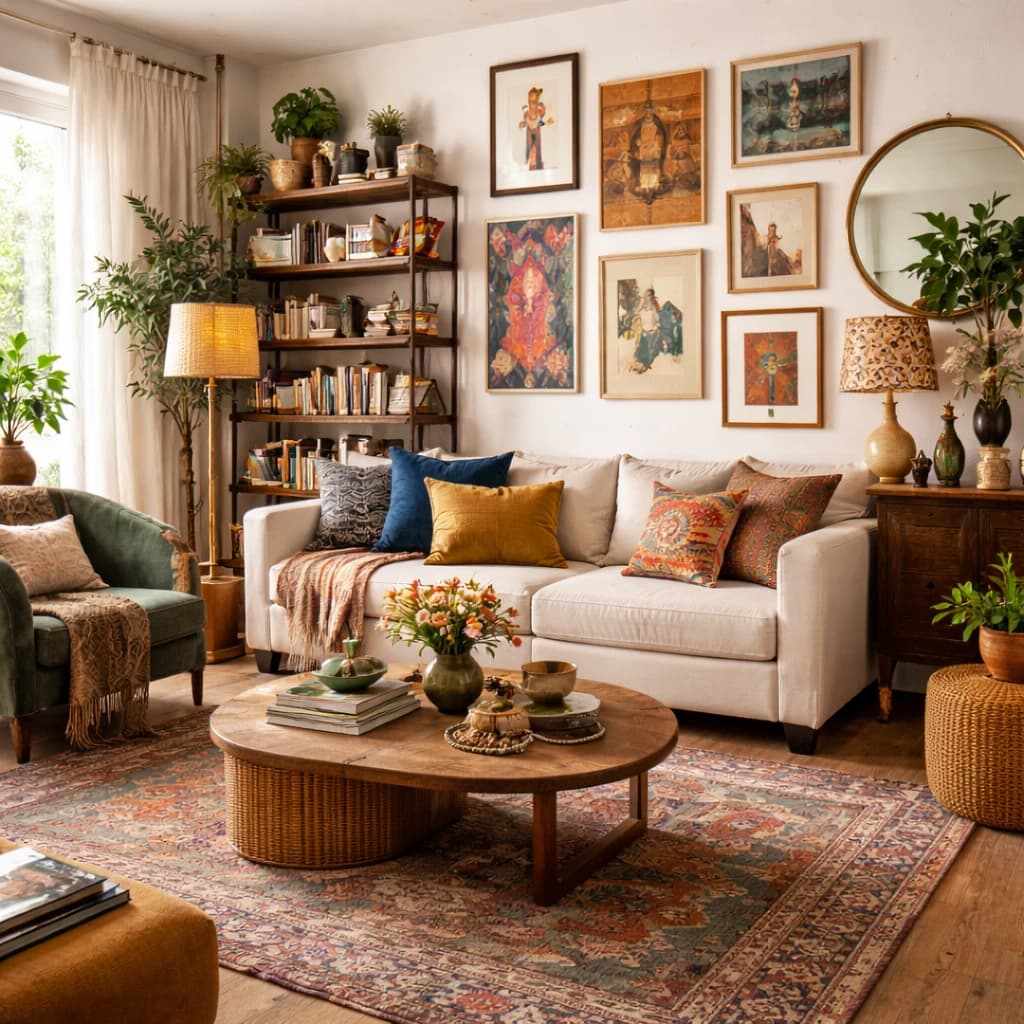
- One anchor piece: a strong sofa, table or cabinet; A chair from a different period than the sofa; A gallery wall mixing art, photography and objects
- Best rooms
- Living room, Home office, Bedroom, Dining room, Entryway
- In Interify
- Eclectic — Mixed styles, personal collection & layered
Where Eclectic comes from
Mixing is older than matching. Before furniture was sold in matching sets, rooms filled up by inheritance, repair and purchase over decades, and the result looked like what we now call eclectic. The word itself comes from the Greek for choosing, and in the nineteenth century it described architects who selected freely from historical styles instead of working in one.
As a decorating approach it was legitimized in the twentieth century by decorators who put a modern chair against an antique table and let the contrast do the work, and it has been the default of design magazines ever since, under names like collected, layered or curated. Its rise tracks a wider preference for rooms that look personal rather than bought.
The mood depends entirely on the pieces, which is why the discipline matters. Successful eclectic rooms almost always share a repeated element: one palette across unrelated objects, one material in several pieces, a consistent furniture height, or a symmetrical layout that steadies a wild mixture. Without a thread, the same objects read as an unfinished room rather than a composed one.
The palette
The colors Eclectic rooms are built on. Name one in a note and Interify works to it.
- Warm white#f3efe6
- Soft clay#c9a28c
- Ink blue#30435c
- Ochre#c08d3c
- Olive#6e7350
- Charcoal#38383a
Materials and key pieces
Materials
- Mixed woods from different periods
- Velvet, linen and wool in the same room
- Brass, chrome and painted metal
- Marble, stone and glass tabletops
- Rattan and cane alongside upholstery
- Ceramic and pottery from several traditions
- Patterned and flat-woven rugs, layered
- Framed art and objects in mixed media
Key pieces
- One anchor piece: a strong sofa, table or cabinet
- A chair from a different period than the sofa
- A gallery wall mixing art, photography and objects
- Open shelves showing a collection
- A patterned rug that holds the room's palette
- Lighting from more than one era
- An unexpected material: stone, cane, lacquer
- Objects with a story, grouped rather than scattered
Do and avoid
Do
- Choose one thread and keep it: a palette, a material, a height or a symmetry
- Pick one anchor piece and let the rest respond to it
- Group small objects into collections instead of spreading them out
- Repeat each color at least twice in the room
- Keep the walls and floor relatively calm, so the mixture reads as deliberate
- Leave space around strong pieces, so each one is legible
Avoid
- Mixing with no thread at all, which reads as unfinished rather than collected
- One piece from every style, which looks like a showroom sample
- Many equally loud items competing for the same attention
- Buying the whole room at once
- Scattering small objects across every surface
- Assuming eclectic means no rules; it needs more discipline than a matched scheme
Rooms Eclectic suits
The rooms this style has the most to say in. It works in any room you can photograph.
- Living room
- Home office
- Bedroom
- Dining room
- Entryway
Make it Eclectic in your own room
Pick Eclectic and it restyles the whole photo — furniture, floor, wall color, textiles and lighting — while the walls, windows, doors and the camera angle stay where they are. Mark anything you want changed on top of that and write what it should become.
Notes to try
- Armchair
- “Replace with a carved antique armchair upholstered in ink blue velvet”
- Wall
- “Gallery wall of mixed frames: one large painting, small prints, one mirror”
- Coffee table
- “Round marble coffee table with brass legs, next to the existing sofa”
- Shelf
- “Open shelf with a collection of mixed ceramics in ochre and olive”
- Floor
- “Patterned flat-woven rug carrying ink blue, ochre and clay”
Photograph the room
Straight on, in daylight, with the whole wall in frame. A phone photo is enough.
Pick Eclectic
Choose Eclectic from the style picker, or write your own instruction for the whole room instead.
Mark and write
Draw around each piece or surface you want changed and write what it should become, as in the notes above.
What it costs to try
- Styles
- 20 interior style presets, or describe your own
- Free to start
- 3 credits on signup, no card needed
- Cost of a version
- 1 credit. Packs start at $9 for 30 credits, down to $0.16 a credit
- Time per version
- Usually about a minute
Questions about Eclectic
What is eclectic interior design?
Eclectic interior design mixes furniture, periods and styles in one room deliberately, held together by a repeated thread: a shared palette, a recurring material, a consistent furniture height or a symmetrical layout. It is an approach rather than a fixed look, which is why eclectic rooms can look completely different from each other.
How do I mix furniture styles without the room looking random?
Pick one thread and hold it. The easiest is color: let every piece share two or three colors, even if their styles are unrelated. The next easiest is height: keep the seating and tables at a consistent level so the eye travels evenly. Then choose one anchor piece and let everything else be quieter than it.
What is the difference between eclectic and maximalist?
Eclectic is about variety of origin: different periods and styles in one room. Maximalist is about quantity and intensity: more pattern, more color, more objects, even if they all come from one style. A room can be eclectic and sparse, or maximalist and perfectly matched. They often appear together, which is why the words get swapped.
Can eclectic style look formal?
Yes. Symmetry is the usual way: a pair of unmatched but equally weighted pieces either side of a fireplace, art hung in a grid rather than a cluster, and a calm wall color will make a wild mixture read as composed. Formality in an eclectic room comes from the arrangement, not from the pieces.
Where do I start with an eclectic room?
Start with what you already own and like, and choose the one piece that will anchor the room. Decide the two or three colors that will repeat, then add slowly, testing each addition against the thread rather than against a style name. Marking one area at a time in a photo of your own room is a quick way to try a piece before you buy it.
Styles like this one
- Bohemian styleA warm, textile-heavy kind of eclectic with a predictable palette
- English Country styleA traditional style that is eclectic by nature, layered over decades
- Mid-Century Modern styleIts furniture is the most common anchor in a mixed room
- Contemporary styleCurrent rooms mix materials and periods freely, which is eclectic practice
- All stylesEvery one of the 20 presets, grouped as the picker groups them.
See your room in Eclectic
Upload a photo, pick Eclectic and mark what should change. You start with 3 credits and no card.