

Asian style
Korean Hanok interior design
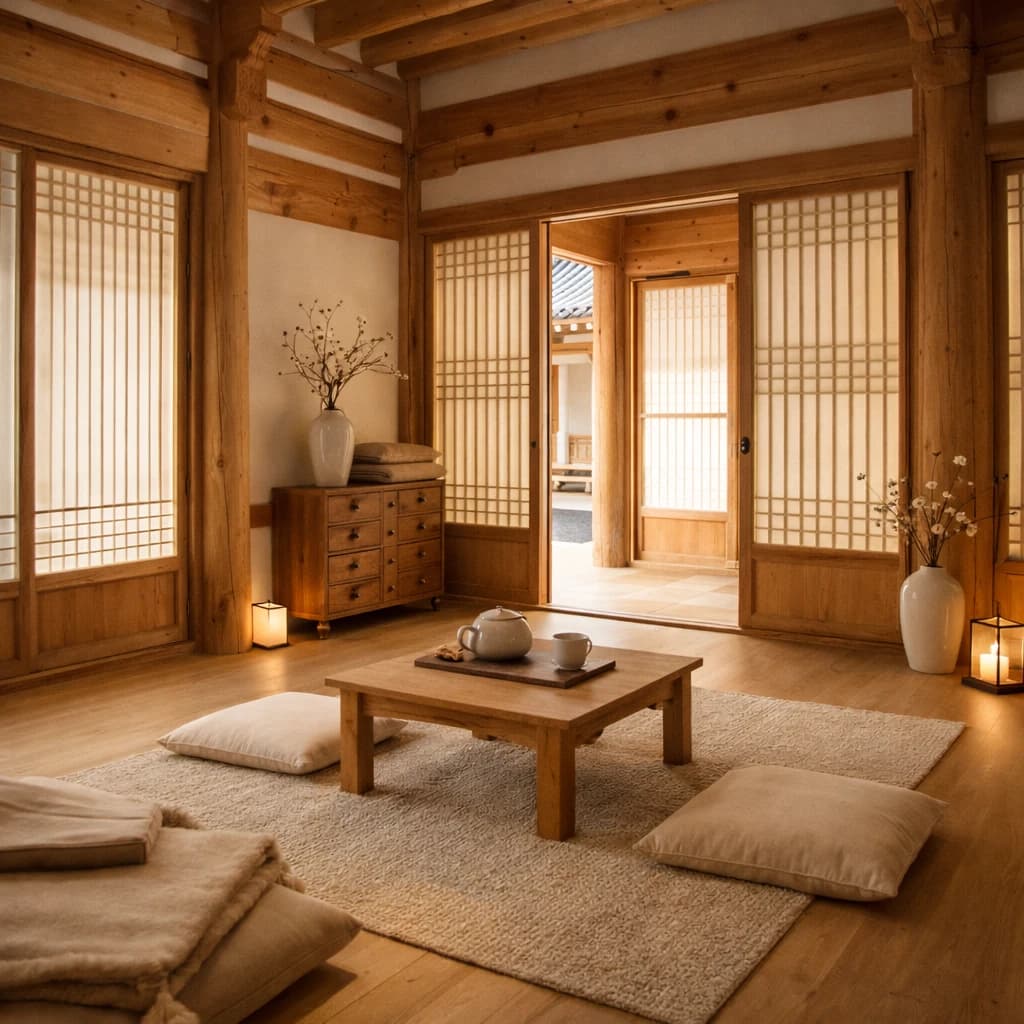
Korean hanok interior design follows the traditional Korean house: an exposed wooden framework, walls and doors paneled with hanji paper, warm floors heated from below, and very little furniture. The effect is understated and horizontal, with living done at floor level.
What defines Korean Hanok
- Colors
- Hanji cream, Oiled paper amber, Pine frame, Ink gray, Celadon, Moon jar white
- Materials
- Pine and zelkova timber framing; Hanji mulberry paper, on doors, walls and floors; Earth and lime plaster infill
- Key pieces
- Sliding or hinged doors with hanji panels; A low soban table and floor cushions; A wooden chest, or a stacked pair, with iron fittings
- Best rooms
- Bedroom, Living room, Home office, Dining room, Entryway
- In Interify
- Korean Hanok — Natural wood, hanji paper & understated elegance
Where Korean Hanok comes from
A hanok is built as a timber frame on a stone base, with earth and lime infill between the posts and a tiled or thatched roof. The structure stays visible inside: posts, beams and rafters are left as finished surfaces, so the room is defined by its frame and by the paper screens set into it rather than by decoration applied afterwards.
Two features shape daily life in the rooms. Ondol, underfloor heating fed from a fire or boiler outside, warms the floor itself, which is why people sit and sleep on it and why the floor finish is the most cared-for surface in the house. Hanji, a tough paper made from mulberry bark, covers the sliding doors and often the walls and the floor, where oiled layers give it a honeyed, leather-like sheen.
The mood is calm, warm and deliberately plain. Rooms hold a low table, a cushion, bedding that is folded away, and a chest or two, so the same space can be used for eating, working and sleeping. Compared with Japanese interiors, the wood is heavier and the finishes warmer; compared with Chinese classical rooms, there is far less ornament and no symmetry requirement.
The palette
The colors Korean Hanok rooms are built on. Name one in a note and Interify works to it.
- Hanji cream#eee3ce
- Oiled paper amber#c9a06a
- Pine frame#8b6f4e
- Ink gray#4b4a47
- Celadon#8fa89a
- Moon jar white#f2efe8
Materials and key pieces
Materials
- Pine and zelkova timber framing
- Hanji mulberry paper, on doors, walls and floors
- Earth and lime plaster infill
- Stone bases, thresholds and paving
- Oiled and waxed floor finishes
- Ramie, hemp and cotton textiles
- Celadon and white porcelain
- Iron and brass chest fittings
Key pieces
- Sliding or hinged doors with hanji panels
- A low soban table and floor cushions
- A wooden chest, or a stacked pair, with iron fittings
- Floor bedding that is folded and stored by day
- A smooth, warm floor as the main surface
- A paper floor lamp or low shaded light
- A moon jar or celadon vessel, placed alone
- A wide, low window or door opening to a courtyard
Do and avoid
Do
- Leave the timber frame visible and let it set the lines of the room
- Keep the floor the best surface in the room: warm, smooth and clear
- Panel the openings in paper so daylight arrives softened
- Work low: a floor table, cushions and a low bed before anything else
- Choose warm, paper-toned neutrals and one celadon or ink accent
- Store bedding and clutter in chests, so the room can change use
Avoid
- Painting the timber frame, which removes the structure from view
- Heavy Western furniture sets that fill the floor the style keeps clear
- Cool gray or blue-white walls against the warm paper tones
- Treating it as Japanese: no tatami, and the frame is heavier
- Red and gold lacquer, which belongs to Chinese classical rooms
- Bright downlighting; keep the light low, warm and diffused
Rooms Korean Hanok suits
The rooms this style has the most to say in. It works in any room you can photograph.
- Bedroom
- Living room
- Home office
- Dining room
- Entryway
Make it Korean Hanok in your own room
Pick Korean Hanok and it restyles the whole photo — furniture, floor, wall color, textiles and lighting — while the walls, windows, doors and the camera angle stay where they are. Mark anything you want changed on top of that and write what it should become.
Notes to try
- Doors
- “Sliding doors with a pine lattice and cream hanji paper panels”
- Ceiling
- “Expose the pine beams and rafters, left natural and matte”
- Floor
- “Warm amber oiled paper floor finish, smooth and seamless”
- Table
- “Low wooden soban table with two floor cushions in natural ramie”
- Corner
- “Stacked wooden chest with black iron fittings and a white moon jar on top”
Photograph the room
Straight on, in daylight, with the whole wall in frame. A phone photo is enough.
Pick Korean Hanok
Choose Korean Hanok from the style picker, or write your own instruction for the whole room instead.
Mark and write
Draw around each piece or surface you want changed and write what it should become, as in the notes above.
What it costs to try
- Styles
- 20 interior style presets, or describe your own
- Free to start
- 3 credits on signup, no card needed
- Cost of a version
- 1 credit. Packs start at $9 for 30 credits, down to $0.16 a credit
- Time per version
- Usually about a minute
Questions about Korean Hanok
What is a hanok?
A hanok is a traditional Korean house: a timber frame on a stone base, filled with earth and lime, roofed in tile or thatch, and finished inside with hanji paper panels. Inside, the wooden framework stays visible, the floor is heated from below by an ondol system, and rooms hold little furniture so the same space can be used for eating, working and sleeping.
What is hanji paper used for in a hanok?
Hanji is a strong paper made from mulberry bark. It covers the lattice of sliding doors and windows, so daylight comes through softened, and it is also pasted on walls and ceilings. On floors, many layers are laid and then oiled, which gives a honey-colored, leather-like surface that is warm underfoot and hard-wearing.
What is ondol heating?
Ondol is Korean underfloor heating, traditionally made by running the flue of an outside fire through channels beneath a stone and clay floor, and now usually done with hot water pipes. Because the floor itself is the heater, the floor became the place to sit, eat and sleep, which is why hanok interiors have low tables and almost no chairs.
What is the difference between Korean hanok and Japanese interiors?
Both use a visible wood frame, paper panels and floor-level living, so photographs are easy to confuse. The differences are in the details: a hanok has a heavier frame, a heated oiled floor rather than tatami mats, warmer paper tones, and no fixed module setting the room size. Hanok rooms also feel less composed, because display alcoves are not part of the plan.
How do I bring hanok style into a modern home?
Work on the floor, the openings and the furniture height. A warm, smooth, clear floor matters most; after that, paper-paneled screens or blinds at the window, a low table with cushions, and one wooden chest for storage. Keep walls in paper-toned neutrals. You can mark the window and the floor in a photo of your own room and try the paper panels before changing anything.
Styles like this one
- Japanese styleA neighboring tradition with paper screens, floor living and a visible frame
- Minimalist styleBoth leave the floor clear and keep very few objects in view
- Chinese Classical styleShares wood joinery and low chests, with much less ornament
- Scandinavian styleWarm pale wood, paper light and plain textiles read similarly in both
- All stylesEvery one of the 20 presets, grouped as the picker groups them.
See your room in Korean Hanok
Upload a photo, pick Korean Hanok and mark what should change. You start with 3 credits and no card.